Products
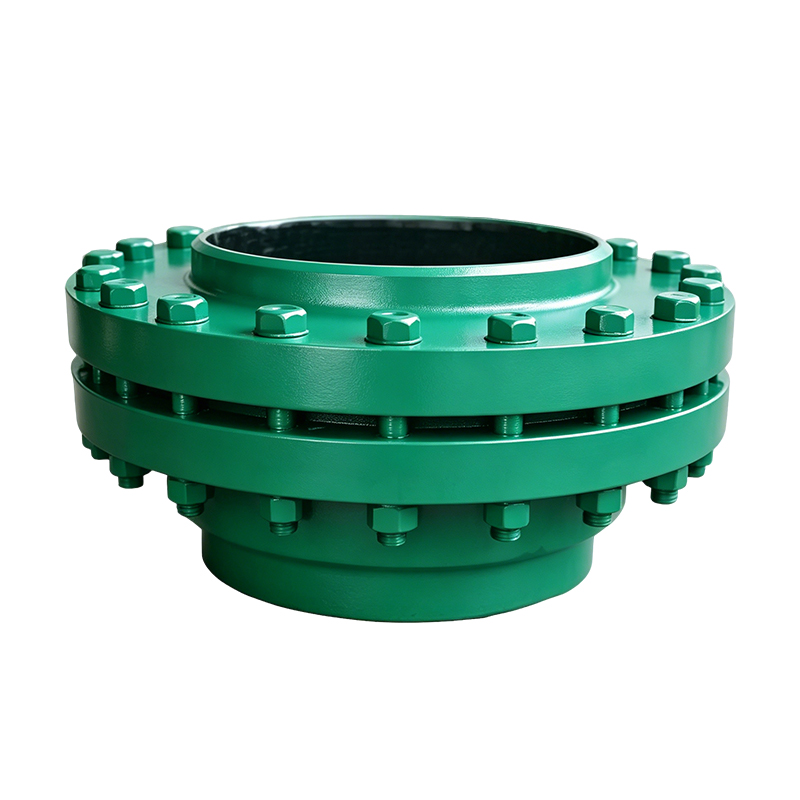
High-temperature High-pressure Thrust-free Rotary Expansion Joint
1. Product StructureThe rotary compensator consists of reducer pipe, inner sleevPhone: +86 18016017868
Email:export@jsxingqiu.com
1. Product Structure
The rotary compensator consists of reducer pipe, inner sleeve pipe, outer casing of sealing seat, flexible graphite packing, bolt-nut and spring assembly, as well as packing gland, and is equipped with matching ball bearings.
For the sealing process of this product, sealing materials are firstly compression-molded by a pressing machine with moderate density to retain good plasticity. Then a certain number of molded packing rings are stacked into the packing cavity, with anti-oxidation additives added inside. Afterwards, secondary integral compression molding is conducted by an oil hydraulic press under specified pressure. Compared with manual wrench compression, hydraulic pressing features more uniform stress and higher compression accuracy. This process integrates all packing rings into a whole, improves the overall density of sealing fillers, and optimizes sealing performance, ensuring zero leakage of the compensator within a service life of 15 to 20 years.
2. Product Development Background
With the rapid development of urban industry, heating pipelines and petrochemical pipelines are continuously upgraded and renovated. In recent years, long-distance compensation pipelines and three-dimensional pipeline networks have been widely applied. A large number of fixed supports are required during pipeline installation, leading to high overall construction costs.
In particular, it is extremely difficult or even impossible to install fixed supports for complex spatial pipeline systems, which greatly restricts the design optimization and popularization of pipeline networks. In response to market pain points and actual engineering demands, our company independently develops and manufactures high-performance rotary compensators.
3. Installation Instructions
1. Application for pontoon pump pipelines: Beveling treatment shall be implemented for pipeline joints before welding. Weld seams shall be subject to flaw detection and hydraulic pressure test in accordance with pressure vessel standards after welding. During the hydraulic test, adjust the sealing compression components until no leakage occurs, and ensure uniform stress on all parts. A torque wrench is recommended for tightening operations.
2. Installation with suspension bridge supports: Install suspension bridge supports strictly following design drawings. The compensator is generally mounted adjacent to suspension bridge supports to adapt to axial expansion and contraction caused by lateral displacement of pipelines. Guide supports shall be arranged on the movable side of the compensator, and fixed supports are mandatory at all pipeline turning points.
3. Heat preservation and waterproofing: The heat preservation and waterproof structure of the compensator can be consistent with that of matched pipelines, but no extra binding force shall be applied to the telescopic sleeve pipe.
4. Installation requirements: The compensator supports installation under all operating temperatures. Pre-tensioning or pre-compression is not required during installation. The sleeve pipe will not loosen under normal operating conditions; simply tighten the compression bolts if loosening happens accidentally.
4. Structure and Product Features
4.1 Complete Structure
The rotary compensator is composed of rotary inner cylinder, packing gland, fastening flange, guiding centering ring, molded flexible graphite sealing filler, sealing compression ring, sealing seat shell, end connecting pipe, bolts and nuts.
4.2 Core Advantages
Adopting mature and reliable sealing technology and dual combined sealing structure, the product has reasonable design and unique structure. It features zero thrust, excellent sealing performance and large compensation stroke, covering all advantages of traditional pipeline compensators. It is widely used in water intake projects, water supply systems, petrochemical, electric power, metallurgy, textile, construction and other industries.
4.3 Optimized Structural Upgrade (Core Product Upgrade)
Most conventional rotary compensators adopt reducer pipe joints to reduce production costs and simplify processing. However, reducer pipes will generate turbulent flow and extra flow resistance in heating pipelines, which negatively affects pipeline flow velocity, flow rate and operating pressure. Besides, reducer pipe joints have large dimensional and geometric tolerance errors, making it hard to guarantee welding quality.
To solve the above problems fundamentally, all our zero-thrust rotary compensators adopt straight pipe joints consistent with standard pipeline nominal diameter, completely eliminating turbulence and flow resistance caused by reducer pipes. This optimized structure ensures stable pipeline operation and reliable welding quality, winning consistent recognition from domestic and overseas customers.
5. Scope of Application
This rotary compensator is suitable for pipelines with all laying forms, including straight pipelines, corner pipelines, parallel pipelines, and pipelines transferring from underground to overhead layout. It compensates axial, lateral and angular displacement generated by pipeline thermal expansion and cold contraction.
6. Customer Parameter Requirements for Customization
1. Provide detailed technical parameters: nominal diameter, working pressure, working temperature, compensation stroke, conveying medium, product model and required quantity;
2. Confirm connecting pipe material: The default material is consistent with matched pipelines (20# carbon steel or Q235B carbon steel). Customized materials are available according to actual working conditions and design requirements;
3. Connection form: Welded connection is the standard configuration. Provide specific flange standards if flange connection is required;
4. Customized service: We support non-standard customized design and production for pipelines with extreme high/low temperature, high pressure, negative pressure, complex pipeline layout and other special working conditions.